Control

Stop
Come to a complete stop, then give way before proceeding.
Common mix-up
↗ RTA handbook · 8th edition, p. 76An empty junction is not permission to roll through.
SHAPE. COLOUR. MEANING.
Recognise the sign, understand the instruction, catch the common trap.
Come to a complete stop, then give way before proceeding.
An empty junction is not permission to roll through.

Yield to conflicting traffic; stop when necessary.
Give way does not grant priority after you pause.

Do not enter the road from this direction.
It does not necessarily mean the whole road is closed.

Continue ahead in the indicated direction.
This is an instruction, not just a suggestion.

Follow the right-pointing direction.
A blue circle instructs; a triangle warns.

Pass the obstruction on its right.
This does not mean turn right at the next junction.

Pass the obstruction on its left.
The arrow refers to the obstruction, not a future turn.

You may pass the obstruction on either indicated side.
Continue to obey the lanes and direction of traffic.

Travel around the island in the arrow direction.
It is not a guarantee that you have priority.

The sign specifies a minimum speed of 60 km/h.
Do not confuse a blue minimum with a red maximum; never force unsafe speed.
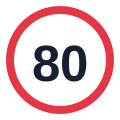
Do not exceed 80 km/h; conditions may demand less.
Enforcement tolerances are not extra legal speed.
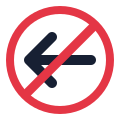
Do not turn left at the restricted location.
Choose a permitted route rather than improvising a turn.
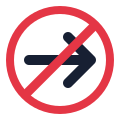
Do not turn right at the restricted location.
The restriction still matters when the road is quiet.
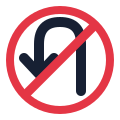
Do not make a U-turn at this location.
A missed turn is not a reason to ignore the sign.
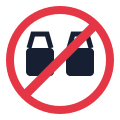
Do not overtake within the signed restriction.
Good visibility does not cancel the instruction.

Vehicles exceeding the displayed height must not pass.
Include roof loads and equipment in the vehicle height.

No discretionary stopping within the signed restriction.
Waiting inside the car or switching on hazards does not authorise a stop.

Do not park or wait during the signed restriction.
Read the supplementary panel and arrows; do not assume stopping is allowed.

A parking area is indicated; check all conditions.
A P symbol alone does not promise free parking.
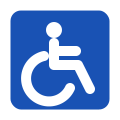
A reserved accessible space; appropriate permission is required.
An empty space is not permission to use it.
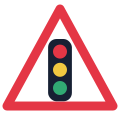
Expect a signal-controlled junction ahead.
The triangle is not itself a red traffic light.
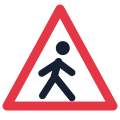
Prepare for a pedestrian crossing.
Look beyond the sign, including the edges of parked vehicles.
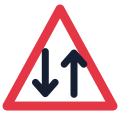
Expect traffic travelling in both directions.
Do not assume both lanes still run your way.

Watch for a junction and conflicting movements.
A warning symbol does not assign priority.

The road meets another road at a T-junction.
Prepare early; assess signs and traffic at the junction.
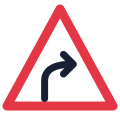
The road bends to the right ahead.
It warns about the road shape; it is not a mandatory turn order.
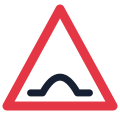
Expect a hump and reduce speed appropriately.
Brake smoothly before the hump rather than suddenly on it.
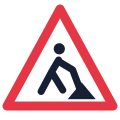
Expect works, workers and a changed road layout.
Temporary signs and markings can change your usual route.
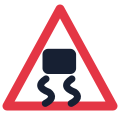
Grip may be reduced; use smooth inputs.
A dry-looking surface can still have poor grip.
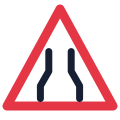
There is less road width ahead.
Do not assume priority where space becomes restricted.

Expect a hazard; read any supplementary information.
The specific risk may not yet be visible.

Freeway conditions and restrictions begin.
This is not a parking or stopping invitation.
Schematic learning illustrations are not manufacturing specifications. Supplementary plates, road markings and context can change what applies. The linked handbook is an older edition; check current RTA materials.